Rokkan, Stein
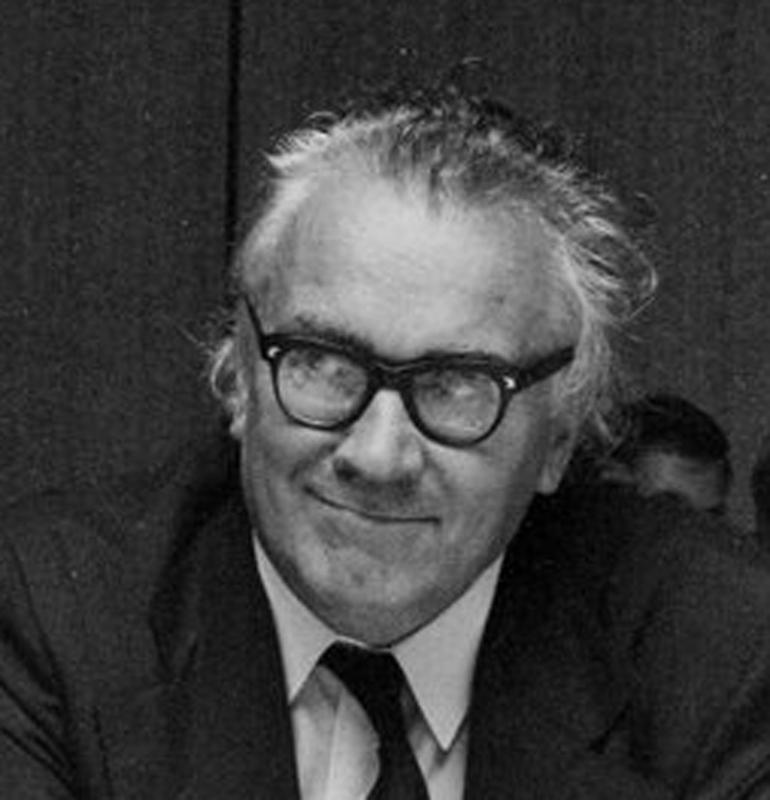
Bio: (1921–1979) Norwegian sociologist and political scientist. Stein Rokkan received his Ph.D. from the University of Oslo and continued his studies at Columbia University and at the London School of Economics. He started his career at the Institute of Social Research in Oslo and then moved to the Christian Michelsen Institute in Bergen, where he founded a department of comparative politics. Rokkan was one of the founders of the International Social Science Council (ISSC), created by UNESCO, and for over 15 years directed cross-national research there. He also served as president of the ISSC. Rokkan was also president of the International Sociological Association and president of the International Political Science Association.
Rokkan's historical macrosociology was based on the historical-comparative analysis. He studied European political development: democratization, formation of party systems, state formation, and nation-building.
Rokkan’s Theoretical and Methodological Approach
Stein Rokkan calls his method “retrospective diachronic analysis”, which uses comparative research across cultures and societies to translate broad “grand theories” into empirically usable frameworks or build “typologies of macro-settings” that can explain variations in human behavior. He was particularly concerned with how such typologies shape decisions about what cultural and geographical contexts can be meaningfully compared at different levels, from societies to individuals.
From this starting point, Rokkan developed a distinctive comparative approach. He emphasized that comparisons must always be context-specific, since no single variable can explain outcomes independently of its broader setting. He also viewed social contexts as multidimensional, emerging from the interaction of political, economic, and cultural systems. Rather than privileging one system over others, Rokkan focused on their combined configurations, rejecting forms of determinism and instead integrating insights associated with thinkers like Karl Marx, Max Weber, and Émile Durkheim.
A key feature of his framework is the importance of territory, particularly within the political system, which ultimately exercises control over it. This focus underpins his twin core concepts of structuring and boundary-building. Political systems develop through the creation of “centers” and the incorporation of “peripheral regions”, alongside the establishment of political, economic, and cultural boundaries. These processes generate enduring divisions, or “cleavages”, especially between centers and peripheries, which shape institutional and organizational structures.
Rokkan also highlights the role of “critical junctures”—major historical turning points such as revolutions—when existing structures are disrupted or „unfrozen”, boundaries become more open, and new decisions reshape systems. These periods of change are followed by phases of “freezing,” during which institutions stabilize, and boundaries solidify. Because macro-contexts differ significantly, Rokkan remained skeptical of universal comparisons, favoring instead historically and regionally grounded models, supported by his method of retrospective, diachronic analysis.
State Formation in Europe
In his analysis of historical cleavage structures, Rokkan treated nation-states not as fixed units, but as outcomes of long-term historical processes. Influenced by Albert O. Hirschman’s concepts of exit, voice, and loyalty, Rokkan examined how nation-states developed through processes of boundary-building, internal structuring, and overall system formation. He identified four key processes that generate loyalty within political systems: state formation and nation-building (primarily boundary-building processes), alongside the establishment of political citizenship (equal participation rights) and social citizenship (redistribution of resources), which involve internal restructuring. In older states, these processes tended to unfold sequentially, whereas in newer states they often occurred simultaneously, creating greater tension.
Rokkan also argued that European state formation was shaped by six major historical factors: the legacy of the Roman Empire, Germanic political traditions, the influence of the Catholic Church, the emergence of a network of powerful cities, feudal agrarian systems, and the development of written vernacular languages. Following the collapse of the Western Roman Empire, Europe experienced fragmentation before gradually reorganizing through expansion and consolidation.
Two elements were especially decisive: literacy and urbanization. The spread of alphabetic writing enabled the standardization of languages, which later supported nation-building. Meanwhile, a belt of economically vibrant cities stretching from Italy to Flanders played a central role in early state formation. Variations in urban structure led to different political outcomes: decentralized city networks delayed state formation in places like Germany and Italy or fostered confederations such as the Netherlands and Switzerland, while more centralized urban systems encouraged the emergence of unified states elsewhere.
These differences contributed to a broader division of Europe along a west–east axis: centralized nation-states in the West, federal structures in Central Europe, and multi-ethnic empires in the East. A second, south–north axis reflected cultural differences shaped by proximity to Rome. Rokkan viewed the Reformation as a key turning point in northern Europe’s nation-building, while Catholic regions retained a more supranational religious structure. Rokkan argued that where territorial consolidation and cultural integration were easier, political development tended to be more gradual and less conflictual, particularly in the extension of citizenship rights.
Political Development of Western Europe
Stein Rokkan’s analysis of democratization in European nation-states focused on how mass politics was institutionally and organizationally structured up to World War II. He introduced the influential idea that democratization proceeds through the gradual removal of four key institutional barriers, or “thresholds.” These include the threshold of legitimation (allowing political opposition), incorporation (expanding political participation through suffrage), representation (access to parliament), and executive power (participation in government).
The reduction of the first two thresholds—through the recognition of civil rights and the expansion of voting rights—marked the emergence of mass politics, characterized by the rise of mass parties and large-scale electoral competition. Rokkan argued that countries with continuous traditions of representation, stable processes of state-building, and the cultural integration associated with Protestantism tended to democratize earlier and more smoothly.
Lowering the third threshold involved shifting from majoritarian to proportional representation, which enabled minority groups to gain parliamentary representation more easily. This change was particularly important in smaller or more socially diverse countries, where pressures for inclusion were stronger. By the early twentieth century, especially after World War I, the spread of universal male suffrage and proportional representation helped stabilize party systems across Western Europe—a process Rokkan famously described as the “freezing” of party systems, many of which remained largely unchanged until the 1960s.
Rokkan linked these party systems to deeper historical divisions, or cleavages, that emerged during earlier phases of state formation and nation-building. These cleavages represent enduring conflicts that structure political competition. He identified several key ones. The “National Revolution” produced the center–periphery cleavage, reflecting tensions between central authorities and culturally distinct regions, and the state–church cleavage, involving conflicts between secular state power and religious institutions. The Industrial Revolution generated the land–industry cleavage, opposing agrarian and industrial interests, and the worker–employer (class) cleavage, dividing labor and capital. A later “International Revolution” added a further division within the working-class movement, between reformist and revolutionary socialism.
According to Rokkan, variations in European party systems largely stem from the first three cleavages, which explain the presence of regional, religious, and agrarian parties. While class-based parties appeared across all countries, their strength and unity varied significantly, particularly due to internal ideological splits within the labor movement.
Main works
Comparing Nations. The Use of Quantitative Data in Cross-national Research (1966);
Party Systems and Voter Alignments: Cross-national Perspectives (1967);
Quantitative Ecological Analysis in the Social Sciences (1969);
Citizens, Elections, Parties. Approaches to the Comparative Study of the Processes of Development (1970a);
“Cross-cultural, cross-societal and crossnational research”, in UNESCO, Main Trends of Research in
the Social and Human Sciences (1970b);
Building States and Nations, 2 Vols. (1973);
Centre–Periphery Structures in Europe: An ISSC Workbook in Comparative Analysis (1987);
State Formation, Nation-building, and Mass Politics in Europe. The Theory of Stein Rokkan (1999).